GUARDIAN LOOP key art CRT-04
● RECCH-04
PLAYABLE ROGUELITE 4XIDLE

GUARDIAN LOOP

A 1993-style space 4X compressed into 30-minute roguelite galaxy runs. Lose the galaxy, keep the data.

▶ CLICK TO PLAY
INSERT COIN — opens in a new window

ABOUT THIS GAME

Every run starts the same: one homeworld, a hostile galaxy, thirty minutes on the clock. Explore, expand, exploit, exterminate — then die to the Guardian and bank everything you learned as Guardian Data. The permanent meta tree spends that data to automate pieces of the 4X, until the strategy game you were losing plays itself while you sleep.

ART & ASSETS

CURRENT RELEASE

v0.11

2026-08-11
  • Every rival species now has a personality of its own, not just a sprite and a stat line. The KHARRAV pick fights on a five-turn clock and attack the moment they are merely even with you. The LITHOX would rather settle another rock than fight you for one. The UMBRYN buy the odds long before the shooting starts. Which neighbours you were dealt is now the first thing worth knowing about a galaxy.
  • Rivals finally research like themselves. Until now every AI empire quietly split its science six ways forever, so they all ended up the same. Now the KHARRAV pour it into weapons, the TALVYN into engines, the CHIRIX and DURVEK into construction, the UMBRYN into computers — scout a rival and its fleet tells you what it has been reading.
  • All ten species have new names: MENTARI, KHARRAV, TALVYN, DRASSK, CHIRIX, DURVEK, URSOTH, LITHOX and UMBRYN alongside the HUMANS. Same kits, same feats, same ladders — new identities of their own. Your existing save is reset by this one.
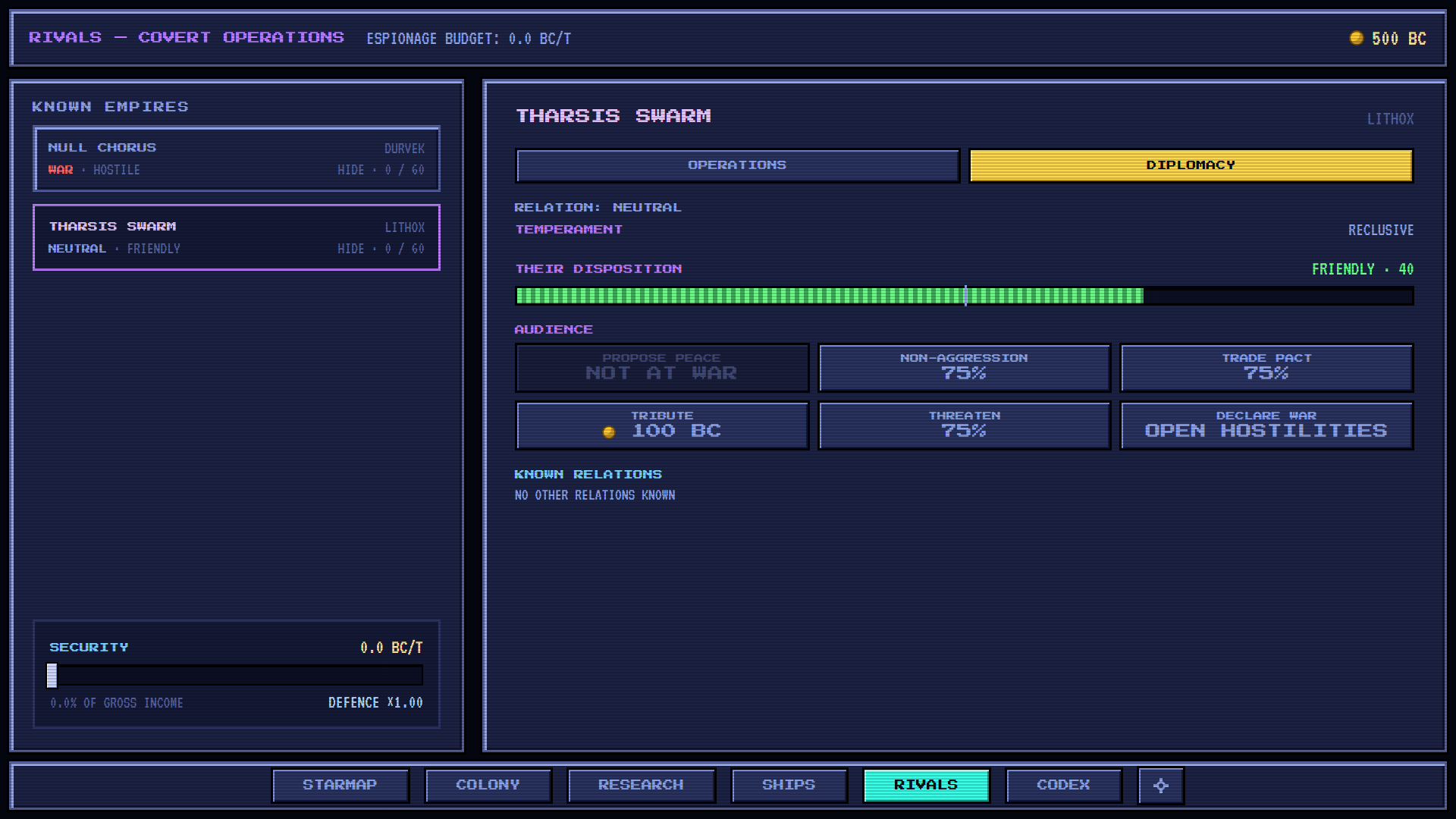
  • You can read a rival's TEMPERAMENT straight off the DIPLOMACY tab, and the codex now says what each species is like to live next to. Neither of them quotes a number — the personality is meant to be recognised from what a neighbour does, and then confirmed.
  • They expand differently too. A DRASSK colony ship goes out barely escorted and always toward the best ground on the map, so a DRASSK neighbour beats you to the good worlds rather than taking them off you later.
  • None of this made the galaxy safer: a player who sits still still loses on three seeds out of three, in around a hundred turns.

ROADMAP

NEXT UP

  • Take manual control of a space battle instead of watching it play out, with the auto-resolving Tactical AI becoming something you upgrade — and never quite as good as flying it yourself.
  • A full difficulty and reward balance pass across the whole run: how fast the rivals escalate, what a galaxy pays out, what the Loop's nodes cost, and a re-tune of combat, espionage, diplomacy and the new species personalities now that all of them have shipped.
  • Colony Governors: save a slider preset to a colony and let it manage itself, then push policies out across the whole empire.

LATER

  • More of the automation ladder — auto-scouting, auto-colonising, automatic troop transports, a ship designer that drafts for you, spy networks that re-fund themselves, and envoys that keep your treaties alive.
  • Rivals that come to you: incoming peace offers, tribute demands and threats delivered to your door, instead of all the asking being yours to do. They have the temperaments for it now.
  • The other five races made playable, with unlocks and talent ladders of their own — they already fight you as rivals.
  • A guide lesson for every system as it lands — flying a battle by hand, running colonies on autopilot, and spending your way up the Loop.
  • Carriers: the biggest hulls launching swarms of one-cell fighters that never had a design of their own.
  • The art still outstanding — portraits for the ten species, orbital defence stations, the planet you are fighting over, the ground battlefield, and the starmap's own icons.
  • Polish pass — a proper soundtrack in place of the current short loops, sounds of its own for war and peace, readable big numbers, alerts for the things worth interrupting you, and keyboard routes through every screen.

MAYBE

  • The Galactic Council: a vote you can win — or refuse, and fight the entire galaxy over.
  • Orion itself, guarded, as a boss worth building a fleet around.
  • An Advisor AI that plays a whole run for you while you are away, and challenge modifiers for when you want the galaxy to fight dirtier.

Plans, not promises — no dates, and any of it can change.

RELEASE NOTES

v0.10

2026-08-10
  • The CODEX. A sixth screen — reachable from the nav bar or the G key, even between runs — holding everything you have discovered: 87 entries across technology, planets, races, hulls and ship components. Entries you have not met yet are just question marks.
  • What you learn is yours forever. Discovery banks across runs, and losing keeps it: concede, get exterminated, walk away mid-galaxy — the codex still remembers every world you visited, every rival you met and every hull you shot at.
  • The GUIDE tab teaches by playing the game. Each lesson is not a screenshot or a diagram — it is the actual screen, driven through the actual clicks, with a cursor and captions. Watch it, replay it, or skip to the end.
  • Seven lessons, and they arrive when they start to matter: your first turns and building a ship from the very beginning, colonising when you scout a free world, invasion once you have an enemy, diplomacy and espionage the moment you meet somebody.
  • Every number the codex shows is read live from the game, and the writing never quotes one — so a stat on a codex page always agrees with the research and ship-design screens it came from.

v0.9

2026-08-09
  • Diplomacy. Rivals now have an attitude toward you and a formal relation — war, neutral or peace — and the RIVALS screen grows a DIPLOMACY tab where you can read exactly how they feel and what the odds are of changing it.
  • Runs no longer open at permanent war. Everyone starts as hostile neutrals, wars are formally declared, and attacking without declaring is a sneak attack — it starts the war for you and the whole galaxy thinks less of you for it.
  • Rivals war among themselves. They declare on each other, raid each other's colonies, sign ceasefires and trade pacts — the map now has a shifting political story instead of everyone permanently gunning for everyone.
  • Audiences resolve on the spot: buy goodwill with tribute, sign a ceasefire, a non-aggression pact or a trade deal that pays both sides, threaten a weaker rival into paying you off — or have the threat blow up into a war on the spot.
  • Don't mistake it for a peaceful galaxy: goodwill decays on its own, rejected proposals sting, and an unattended neighbour still slides toward declaring on you in about ten turns. Peace is something you maintain, not something you get.
  • Humans finally play their hook — a 25% diplomacy bonus — and the Loop's Statecraft branch grows an ENVOY CORPS node that sharpens every audience.

v0.8

2026-08-07
  • The game has sound. Buttons click, research breakthroughs chime, beams and missiles land with their impacts, colonies you lose sound like a loss, and there is music underneath all of it.
  • Battles are the big one. Every shot, hit, miss and exploding ship has its own sound, and watching a fleet action now plays as a fight rather than a slideshow of coloured lines.
  • Three pieces of music that follow where you are: one for running your empire, one for combat, and one for THE LOOP and the run-end tally. They cross-fade as you move between screens.
  • A gear button on the bottom bar opens volume controls — master, music and sound effects on separate sliders, plus a mute switch. M mutes from anywhere. Your settings are remembered, and they survive wiping your progress.
  • It stays out of your way. Fast-forwarding a run is completely silent, a busy turn plays at most three sounds, and skipping a battle resolves it without a peep.

v0.7

2026-08-06
  • Pick your race. Every run used to be Humans; now the new-run screen is a real choice, and each card tells you exactly what that race does before you commit to it.
  • Four new races unlock by playing their style, not by paying for them. Finish a tech ladder and the Psilons are yours. Hold six colonies at once for the Silicoids, land five spy missions for the Darloks, build one world up to 120 factories for the Klackons. Progress counts on runs you lose, and your best attempt is always shown on the locked card.
  • Every rival now plays like its species too. A Psilon neighbour out-researches you, Bulrathi hit far harder on the ground, Silicoids settle worlds nobody else can reach, and Mrrshan ships shoot straight. Scouting who you are next to finally matters.
  • The races play genuinely differently. Silicoids never generate pollution at all and can colonise any planet in the galaxy, but they breed at half speed. Psilons research 30% faster and spy badly. Klackons out-produce everyone. Darloks are simply better at espionage than anybody.
  • Race talents in the Loop: each playable race has its own short ladder of Guardian Data upgrades that deepen what it is good at. They only apply while you are actually playing that race, so a bought-out Psilon ladder does nothing on a Klackon run.
  • The run-end tally now tells you the moment you have earned a race — including on a defeat, which is exactly when you want the good news.

v0.6

2026-08-06
  • Spies and sabotage. There is a new RIVALS screen where you fund a covert network against each empire you have met, then point it at what you want: sit quiet and build it up, steal a technology you never researched, blow up missile bases and factories, or incite unrest on one of their worlds.
  • Your rivals do all of it back. They will steal your tech, wreck your industry and freeze your colonies — and you often will not know who did it. The name of the empire behind an attack only shows up when you catch their agents in the act.
  • A world under unrest produces half of everything and cannot be given new orders at all — its sliders and its build queue are locked until the agitators are cleared out.
  • Patience pays. A network only ever runs one mission per rival per turn, but points banked beyond the next mission make it far more likely to succeed and far less likely to get caught, so sitting on HIDE and waiting is a real strategy. The screen shows you the exact odds.
  • Counter-intelligence comes from two places: your Computers research, which now finally does something outside the shipyard, and a security budget you can raise at any time.
  • The Statecraft branch of the Loop has been rebuilt around all this — five steps ending in a node that halves what every mission costs, instead of just nudging your payout.

v0.5

2026-08-05
  • A behind-the-scenes release: no gameplay changes, just tooling that makes the next few a lot faster to build.
  • Testing the game used to mean playing twenty minutes to reach the interesting part. There is now a set of named starting points — a battle about to happen, an invasion about to land, a developed empire, a run one strike from victory, a run one strike from defeat — that can be jumped to instantly.
  • Each of those is rebuilt from the live rules every time it is used and checked automatically on every change, so a balance tweak that quietly breaks one gets caught the same day instead of weeks later.
  • Your existing save is unaffected.

v0.4

2026-08-05
  • Ships are real ships now. Every hull, on every screen, is hand-drawn pixel art instead of a coloured rectangle — on the battle grid, on the blueprint, in your design roster, and as the fleet markers moving across the starmap.
  • Big ships take up real space in a battle. The tactical grid is far finer than it was, and a hull now occupies a footprint rather than a square: a fighter takes a couple of cells, a dreadnought sprawls across a wide block. Ships block each other, weapons range from hull edge to hull edge, and missiles hit where the ship actually is. Manoeuvring a big ship out of a corner is now a genuine problem.
  • Pick the artwork for each of your designs. The ship design screen has an ART cycler — flip through your species' hulls of that size and choose the one you want. It is the ship you will see fighting your battles and crossing the map, and it locks in once you have ships in service.
  • Every empire looks different. Your rivals are drawn from ten distinct fleets — insectoid, crystalline, stealth-black, gold swept-wing — dealt fresh each run, so you can tell whose ships are in orbit at a glance. It is pure identity: nobody gets a hidden bonus for it.
  • Fleet markers show what is actually in the fleet. The marker is the most valuable ship you have got there, in its own artwork, so a scout on a survey run and a battleship stack heading for your border no longer look identical.
  • Existing saves are cleared by this release.

v0.3

2026-08-04
  • Sending a fleet is one click now. Hit SEND FLEET and the ship picker opens straight away with everything aboard selected — every star that group can actually reach lights up with a ring and the number of turns it takes to get there, and clicking one launches. No more picking a destination first and hoping.
  • The map finally tells the truth about range. Drop the colony ship out of the group and watch the highlighted area grow, because your scouts carry reserve tanks and can go further. That was always true in the rules; the old map just refused to show it.
  • Every production slider and research field has a padlock. Lock the ones you have already decided about and drag the rest — the locked values do not move an inch, and the leftover percentage redistributes between whatever is still unlocked.
  • Your ECO slider now has a marked CLEAN point: the exact setting that keeps pollution at zero. Drags snap onto it, sitting below it warns you that waste is rising, and when a cleanup breakthrough lands, colonies parked on that mark ease down to the new one automatically and hand the freed output to your other sliders. Locked or deliberately over-invested colonies are left exactly as you set them.
  • The research screen swapped its little arrows for the same draggable sliders the colony screen uses, so allocating research feels like allocating production.
  • Planet portraits are sized by the world: a size-10 rock is visibly a rock next to a size-90 homeworld, on the map panel and the colony screen both.

v0.2

2026-08-04
  • Two bigger galaxies to conquer: SMALL puts 24 stars and 3 rivals in front of you, MEDIUM 48 stars and 5 — and the bigger the galaxy, the bigger the Guardian Data multiplier on everything you bank when the run ends.
  • You can earn your way up or buy your way up: SMALL opens after 3 TINY victories or the UNLOCK: SMALL GALAXY node in THE LOOP, MEDIUM after 2 SMALL victories or its own node. Whichever comes first — so a run of bad losses still walks you up the ladder.
  • The new-run screen is a real picker now: click the galaxy you want to play, and a locked one tells you exactly what it is waiting for (your win count so far, and the Loop node that would skip it).
  • The starmap pans and zooms. Drag the map to move it, roll the wheel to step in on a MEDIUM galaxy until every scouted system is showing its name. TINY still shows you the whole map at once, exactly as before.
  • Win a run and the tally now tells you what the win was worth to the ladder — TINY WINS 2/3 → SMALL — and lights up when it is the one that opens the next galaxy.

v0.1

2026-08-02
  • Ground invasions are now a battle you can watch: land your transports and a WATCH / SKIP prompt pauses the turn clock, then troopers trade fire while the troop counters tick down round by round, at 1x/2x/4x or skipped instantly.
  • Both sides of an invasion get the playout — hold a colony against a rival landing and you watch your own defenders make their stand.
  • Your ground research shows up on the battlefield: HAND LASERS and PERSONAL BARRIER read out as an advantage line against the enemy's, and they decide the fight.
  • First public build of Guardian Loop: a 4X roguelite that compresses Master of Orion into repeatable galaxy runs against brutally strong AI rivals — colony sliders, six randomized research ladders, per-empire ship design, and grid space battles you can spectate.
  • Losing is not wasted: every run banks Guardian Data into a permanent meta tree whose headline reward is automation — you start out clicking END TURN like it's 1993 and buy your way toward an idle game.